| In light of the rapidly approaching holiday week, I’ll take it easy on you this week. Let’s chat about Center of gravity and Sweet Spot. Lot’s to talk about here… Center of Gravity (also called center of mass) is a fixed point inside a body where mass is evenly distributed in every direction. Up vs down, heel vs toe, front vs back. All the same relative to each other. You might be thinking “I can see that this should be important, but I’m not sure why.” You’re right and you’re not alone if you don’t know why. Here’s why, and let’s dig a little deeper. First, let’s start with an easy one to understand – a golf ball. Everything has a Center of Gravity. A golf ball is easy because it’s round in every direction (it better be). Assuming all the layers on the inside are in perfect alignment with each other, the center of mass will be in the dead center of the inner core. If it’s not, the ball won’t roll straight or fly straight, right? That’s pretty easy to understand, right? If we move on to a golf club head, we should go backwards in time first. In the golden age of club head design, pretty much everyone designed them the same way or so similarly that the center of gravity was in roughly the same place. Then cavity back irons and metal woods came about. We (manufacturers and designers) had options. Flexibility. We could actually reposition weight and have the club do different things. I want you to try an experiment. See if you can find an old muscle back blade iron and the largest oversized cavity back iron you can find. Put the 2 clubs next to each other and let them hang down like you are plumb bobbing. Hold the butt caps lightly between your fingers. When you do this, gravity will make the center of mass form a vertical line between that point and the fixed point (your fingers holding the shaft). See how they hang differently? Notice the heel on the oversized one is further back? (to save you the trouble, I did it for you. Pictures are below. ;)) This means the center of mass on the oversized clubhead is further towards the toe, while the blade is further towards the heel. Makes sense, doesn’t it? This is how we can understand WHERE the Center of Gravity is located in the clubhead. So you’ve heard “lower and deeper CoG”. Mass forward equals less spin, lass stability, harder to hit and control. Mass deeper (back, not down) does the opposite – increases spin, more stable, easier to hit. Mass up will lower the flight, while mass down will increase the height of the shot. Using different materials (like tungsten) will allow concentrated pieces of weight to be strategically placed inside a club head. This creates “discretionary weight” that we can further move around (or remove) giving a ton of flexibility in design. In the example where we let the clubs hang, the mass moved further towards the toe or heel depending on the club we selected. Can you think of certain golf swings that would be better suited for one type of weight pattern over another? If you are fitting and you can look at a players 7 iron, you may be able to see a wear pattern (if not, use face tape). If the wear pattern is on the toe side of center, perhaps a club weighted that way might be better (ever see an “over the top” swinger with a wear mark on the toe?)? I hope you can see how certain players would prefer certain CoG locations. I also hope you can see why we offer so many different models – we are now able to specifically target very small player groups. We can make an iron just for any player type. If this sounds a lot like “sweet spot” to you, you’re not alone here either. Contrary to the way most people talk about golf clubs, Sweet spot and Center of Gravity are NOT the same thing. Center of Gravity, as we learned above is a fixed point inside the head where the mass is equal in every direction – a balance point. The sweet spot is an area of the face where maximum energy is transferred at impact. If these two now sound unrelated – they are not. In fact, they are directly related (hence the reason I put them in the same section. Haha). If you take the CoG Point and envision a cone emanating towards the clubface from that point, that is your sweet spot (actually, “sweet area” is a better term). The deeper the CoG, the larger the sweet area. The larger the sweet area, the more consistent the club will be across a wider area on the face. Up above, I mentioned “Lower and deeper CoG”. A lower CoG makes the ball go higher while only slightly influencing Sweet Spot size. A deeper CoG, on the other hand has a tremendous influence on Sweet spot size. The deeper we can make it, the bigger the sweet spot. Essentially, the more forgiving it is on off center hits. But… There’s a catch. Of course there is. Question for you. Is a larger Sweet Spot always better? The answer is generally yes, but no – it depends on the player. There is a trade off. As the sweet spot gets smaller, it gets more concentrated – more concentrated = more precise. How could it get smaller? Remember the definition – Sweet spot is a cone coming from the CoG. If it’s further forward inside the head, it will be smaller. In English, it’s more solid feeling if the sweet spot is smaller. The true hidden benefit is if it’s smaller, your distance control when hit in that area will be much more consistent. Hold on, hold on… I just said up above that a larger sweet spot was more consistent – how can a smaller sweet spot be more consistent too??? The answer is they are consistent in different ways. A LARGER sweet spot is more consistent when the shots are struck OFF the center of the face (the bigger the miss, the less variance from a center strike). A SMALLER sweet spot is more consistent ON the center of the face (more consistency on that spot, but much more inconsistent OFF that spot). What this translates to is a shot hit in the sweet area of an oversized cavity back may have a variance of 2-3 yards, while a shot hit in the center of the face in the sweet area with a muscle back iron might be measured in inches. If you’re a very good ball striker, this would be very important. By contrast, if you’re hitting it all over the face, the 2-3 yard variance is not even a discussion point. Of course, if you miss the sweet spot with a muscle back iron, the loss will be significantly greater (10-15% in yards – a 150 yard 8 iron 1/2″ off the center might go 135 yards). Say, for a second that you’re a tour player. You don’t consider missing a shot by 1/8″, much less 1/2″. Your distance control will be much more precise with a smaller club head with a smaller, more concentrated sweet area. +/- 2 yards is 6 feet. The difference between 6 feet for birdie and 12 feet for birdie over the course of a PGA Tour season is a very, very big deal. They play yardages to the yard, not to the green. The better the player, the more they can relate to that… Perhaps you can understand WHY a certain player may prefer a certain head shape or style. When you fit a player, use face tape early on. It will tell you where he strikes the ball, and his impact pattern will tell you where to go with head selection. I hope this helps. You don’t need to know where the CoG is in a head or how big the sweet area is – you can tell by looking at it. The larger and deeper the head, the larger and less concentrated the sweet area is. That will tell you what he should be playing and give you insight as to what he might find when he switches from his current clubs. All of this is good knowledge for you to have but probably not something you need to share. Understanding it will help make you a better fitter. Oh, last thing… this applies to everything – Drivers through putters. I want to wish you a Merry Christmas and a Happy Holiday season. Enjoy the time with family and friends and hopefully some well deserved time off. Speaking of which, I will be taking next week off from this letter. It’ll return in early January. HOHOHO!! 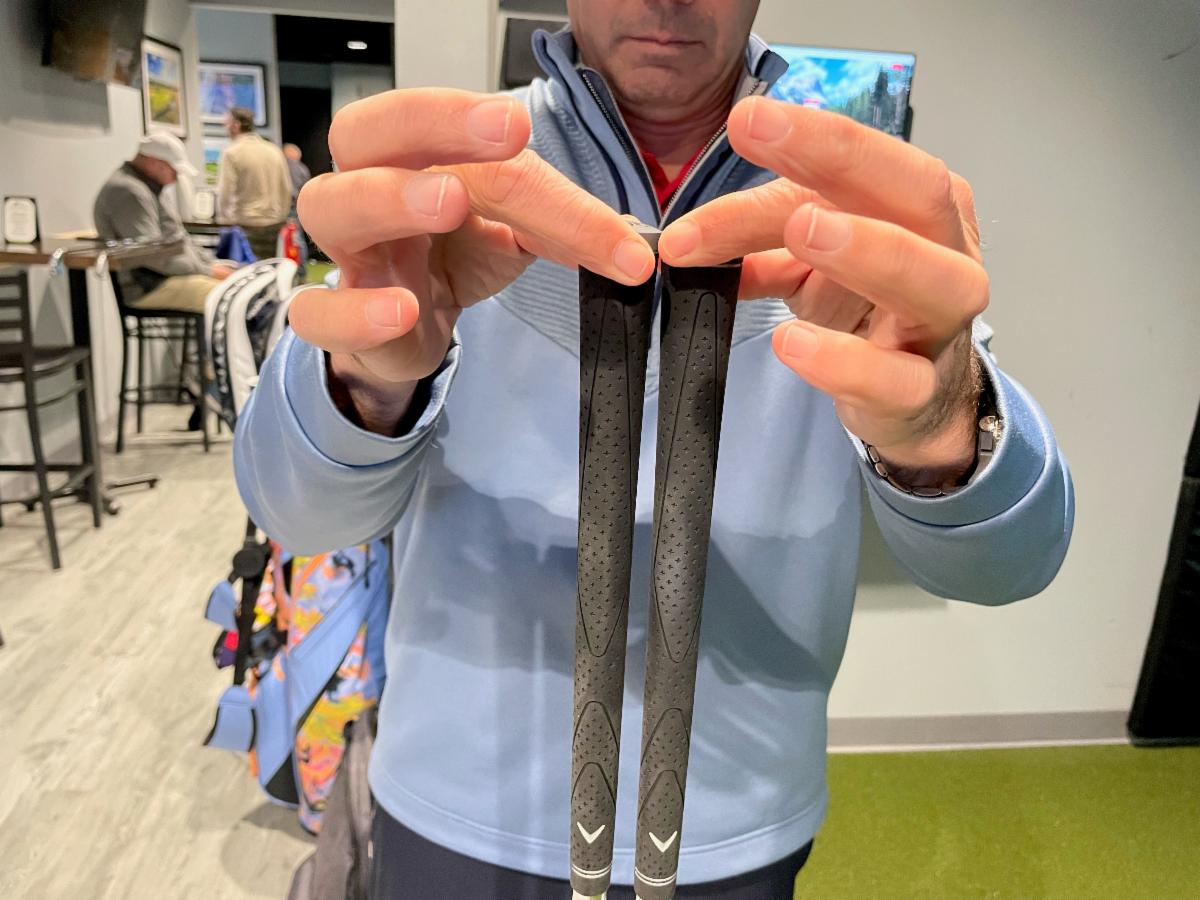 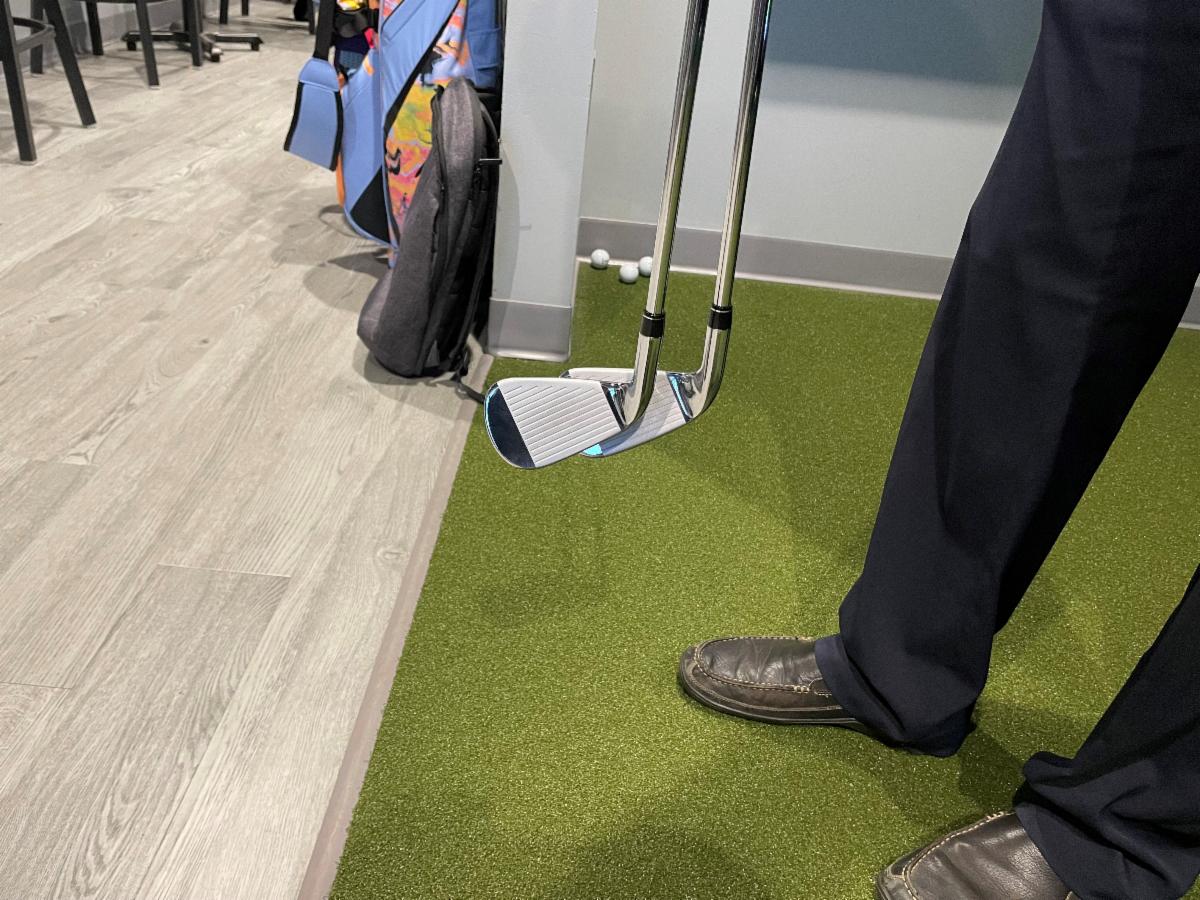 |
- Comment
- Reblog
-
Subscribe
Subscribed
Already have a WordPress.com account? Log in now.
 Jim Yeager Golf
Leave a comment