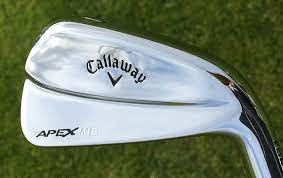
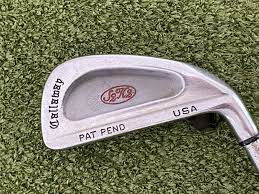
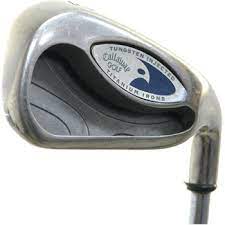
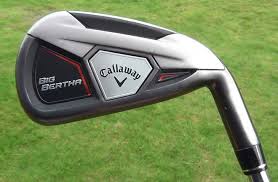
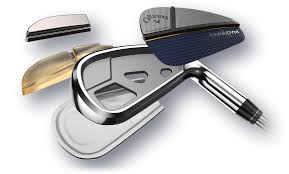
| Three weeks ago, we talked about when to teach vs. fit. Two weeks ago, it was how to turn bad shots into a positive when fitting. This week, let’s dive into HOW the equipment is made to be able to do what it does to assist on these shots. Today, we’ll talk about the “Evolution of Forgiveness”. To start, let’s take a trip down memory lane. Below is kind of a timeline of irons and how they’ve evolved over the years – scroll down, I’ve got pictures!! The MB is a newer model, but similar to irons of that type from years gone by. If you start with the Muscleback/ blade style iron, you’ll see that there is a single piece of steel and weight is spread evenly across the back. This iron head style was prevalent through the 1950’s and is still found in Professional bags around the world. This head style creates a very defined sweet spot that is great on center hits, and increasingly less great the further the contact is away from the center of the face. As you move to the old S2H2 from the late 80’s, you can see the start of a cavity back (Iron heads like this started in the 1960’s). This modest cavity moved mass away from the center to the outer edges (perimeter) to place more mass away from the center. In so doing, the center strikes weren’t quite as good, but the off center strikes were much better. A player would still have to be a pretty good player to play something like this. Next up is the Hawkeye from the early 2000’s. As you look at this iron, you’ll see the undercut cavity on the back/ bottom of the club head. This is designed to move weight AWAY from the back side of the face (for stability), and DOWN (to aid in launch). This mid 2000’s technology made irons extremely more forgiving. There was still a distance loss on off center hits, but they were much better, and much, much easier to launch. Next up is the Big Bertha from 2014. What happened to the undercut cavity? This was the start of the Hollow body iron era. Engineers figured out that if you put a back on the cavity, you could use that whole internal area to reposition weight and significantly improve distance consistency on off center hits (more on this later). Also added in here (for Callaway), was a feature called “Cup Face”. Not only was the face a separate piece from the rest of the body, it was welded to the body in a series of recessed joints, so the welds weren’t on the corners (read: edges) of the club face. Welded joints are rigid and they don’t bend. Putting them on a corner that wants to bend makes them ineffective and almost negates the reasoning behind making the face a separate piece. This single piece of technology that is still used in every multi piece Callaway iron today and plays one of the biggest roles in distance gains in irons over the last 10 years. This increase in performance instantly vaulted Callaway to the Number 1 Iron in golf – a position it still holds today. You can see the cup face technology if you look at the picture of the Paradym Iron below. If you look at the back side of the clubface, you’ll see extra metal around the edges of the face. This is Cup Face. Finally, a picture of the new Paradym iron with all of the pieces. This iron has everything an iron needs for forgiveness, but can also use materials that make it feel like the finest forged clubs. The body is significantly lighter, and that weight is replaced by large pieces of tungsten. Cup face allows the face to flex all across the face – especially on the bottom. As you look at the frame, you’ll see it’s filled with a metal “bracing system” – this is essentially jailbreak for an iron – it keeps the body from flexing at impact, which allows all of the energy delivered to the ball to be transferred to the ball to get maximum ball speeds off the face. This “iron” is essentially made like a fairway wood – it just happens to be shaped like an iron. It even uses the same materials as a fairway wood. Welcome back to 2023. Hopefully you can now understand what has gone into clubs over time to make them easier on your scorecard when you mis-hit them, but… what’s the reality? What are these going to do for me?? Smash Factors with todays irons are routinely higher than the 1.35 that we use as the “gold standard” of iron impact. I will routinely see ball speeds of 116 MPH for an 80 MPH club head speed. That is a 1.45 smash. A good driver ball speed for an 80 MPH club head speed would be 120 MPH. We can approach that with a 7 iron now. That is a testament to just how efficient todays clubs are!! Years ago, when we would fit someone for irons, we would do whatever we needed to do to try to get center contact. This was the only way to get the maximum ball speed and performance out of a club. Today, we hardly even look at it any more. Yes, center contact is 100% better, but, the ball speeds generated on off center contact are so good, that it almost doesn’t matter any more. Essentially today, a square face (to make the ball go straight), and a good attack angle (to achieve the desired launch conditions) are much more important than where the shot was struck on the face. Today’s clubs have made it so. Try it for yourself. Take a game improvement, hollow body iron (like a Paradym iron) out to the range and hit them high, low, heel, or toe and look at the ball speeds vs. center strikes. Try it with an old muscleback iron and note the differences… To make it easy for you, I did this last week. I used the same Nippon Modus 120 Stiff flex shaft that I play in my irons throughout this test. I hit 3 shots with each of 5 club heads (Paradym, Apex, Apex TCB, Apex MB, Rogue). Any mis-hits were noted and reported separately. Paradym Club head speed 85 MPH, Ball speed 119 Apex Club head speed 85 MPH, Ball Speed 116 Apex TCB Club Head Speed 87 MPH, Ball Speed 114 Apex MB Club Head Speed 88 MPH, Ball Speed 112 Rogue Club Head Speed 84 MPH, Ball Speed 118 This test took 18 shots, so fatigue was not a factor. Interesting how my Clubhead speed went up as the heads got smaller (smaller body = better aerodynamics?). Also interesting how the ball speed numbers were lower with these same clubs despite center contact. I hit a very thin shot with Paradym, with Apex TCB, and with Rogue. Ball speed with the thin shot with Paradym was 114, with Rogue it was 114, and with Apex TCB it was 103. With Paradym and Rogue, these shots had less carry than well struck shots, but bot ended up within 8 yards of a good shot with the same club. The Apex TCB Shot was also on the toe, and was 26 yards short of a good one. Full disclosure, I tried to hit it thin, heel and toe with each club to get more data for this test, but I couldn’t hit it in those spots consistently enough to get good data – the numbers were all over the place. Rather than practicing hitting bad golf shots, I decided enough was enough. 😉 Haha. Also of interest, the spin was the highest with the Apex TCB and Apex MB as expected (both were in the 6800-7000 range), while the others were all in the upper 5000’s to low 6000’s. Dispersion was the worst for me with the Apex MB – they were very easy to hook. Apex TCB was better, but all 3 shots finished left of my target line. Conversely, all three shots with Rogue finished right of my target line. Perhaps the weighting in the toe to make the iron forgiving made it harder for me to square the face? Understanding this will help you fit and help your members and customers. I hope this helps!! Happy Fitting. |
 |
    |
 Jim Yeager Golf
Leave a comment