| Last week we talked about WHY today’s irons go so much further. We started with the loft discussion. I hinted at multi-materials being used – specifically, Tungsten. So, why Tungsten? Tungsten is a very dense, and very hard metal. It doesn’t have much resistance to corrosion, but it is very resistant to heat (with a melting point of over 3400* C). This makes it not so ideal for a club face (it would feel awful). It is PERFECT, however, for a piece of discretionary weight where size is an issue (like inside a club head, where it will not be exposed to the elements of nature). While density is not the only measure of a materials worth, it’s an interesting comparison. Aluminum is a lightweight metal that has a density of 2.7 g/cubic centimeter. It’s fairly strong, and has nice resistance to corrosion. Stainless steel, on the other hand, is heavier and more dense (7.9 g/ cubic CM). Tungsten is extremely dense at 19.3 g/ cubic CM) – one of the most dense materials known to man. OK Cool. Now, where does Titanium fall in? Tungsten is the strongest of any natural metal at 142,000 psi, while Titanium has a Tensile strength of 63,000 psi. Titanium is great for thin, light applications that are strong and won’t shatter at impact. Sound like a driver face?? If it’s so great, why not use it in an iron head? Simple… Cost. And application. A Ti Iron head would be in the $350-$400 range (just like a driver). The strength would be overkill, and the harder feel would not be as ideal as stainless or carbon steel. It would be cool for a milled face on our Ai One Milled putter line, though. 😉 The bottom line is the properties of each of these metals are unique, and that makes them hard to compare to one another. It also makes them easy to compliment one another and use them together in a single application. Why is this important, and why is this relevant? Simple. Take a look at a club head from 20 years ago. It was one piece of stainless steel. Uniform density and the weight was distributed to the best ability of the manufacturing process. Remember milled cavities? We did that because we couldn’t figure out how to get the weight back away from the club face via manufacturing – so we made the raw head with it as a solid block of steel then milled it out. Today? We make most heads out of 4 different pieces. The resulting club head is hollow. 3 different metals with a gel injected inside. Each metal has a different density and has a specific place in the design application. Shave some weight from here, and add more here… See the image below of the pull apart head from a Paradym Iron. Upper left is a piece of Tungsten. That goes low and in the toe. Just below that is a piece of Urethane (gel with air bubbles manufactured in). The face is forged out of carbon steel, and the body is machined from stainless steel. Add a badge for vibration and sound dampening, and there you have it. 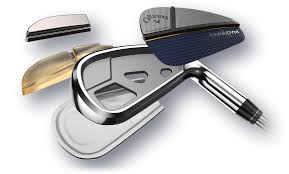 |
| Now, if you think about a driver… bigger body, right? We can use multiple materials that we might not use in an iron – like Titanium and Carbon fiber. Stronger than steel, lighter than steel. I hope you can see the value of using new and different metals in a club head. Each of these designs allows the R&D team to remove weight from the head. Remove weight? Doesn’t the head weight need to be relatively fixed? YES!! When we remove weight, from one area it will lighten the overall weight, so the weight needed to get it back to the necessary weight is called Discretionary weight. Being able to place this exactly where we want to to make the ultimate distance machine, or game improvement machine, or a blend of both is how this is achieved. As you look at the club head that is pulled apart above – does it make sense now why costs have escalated in club heads? More than just a chunk of metal that is shaped to look like a golf club, eh? Fun fact.Callaway spends over $150M in R&D annually. This is the most of any company in the golf industry by a long shot. In fact, more than the next three competitors combined!! |
 Jim Yeager Golf
Leave a comment