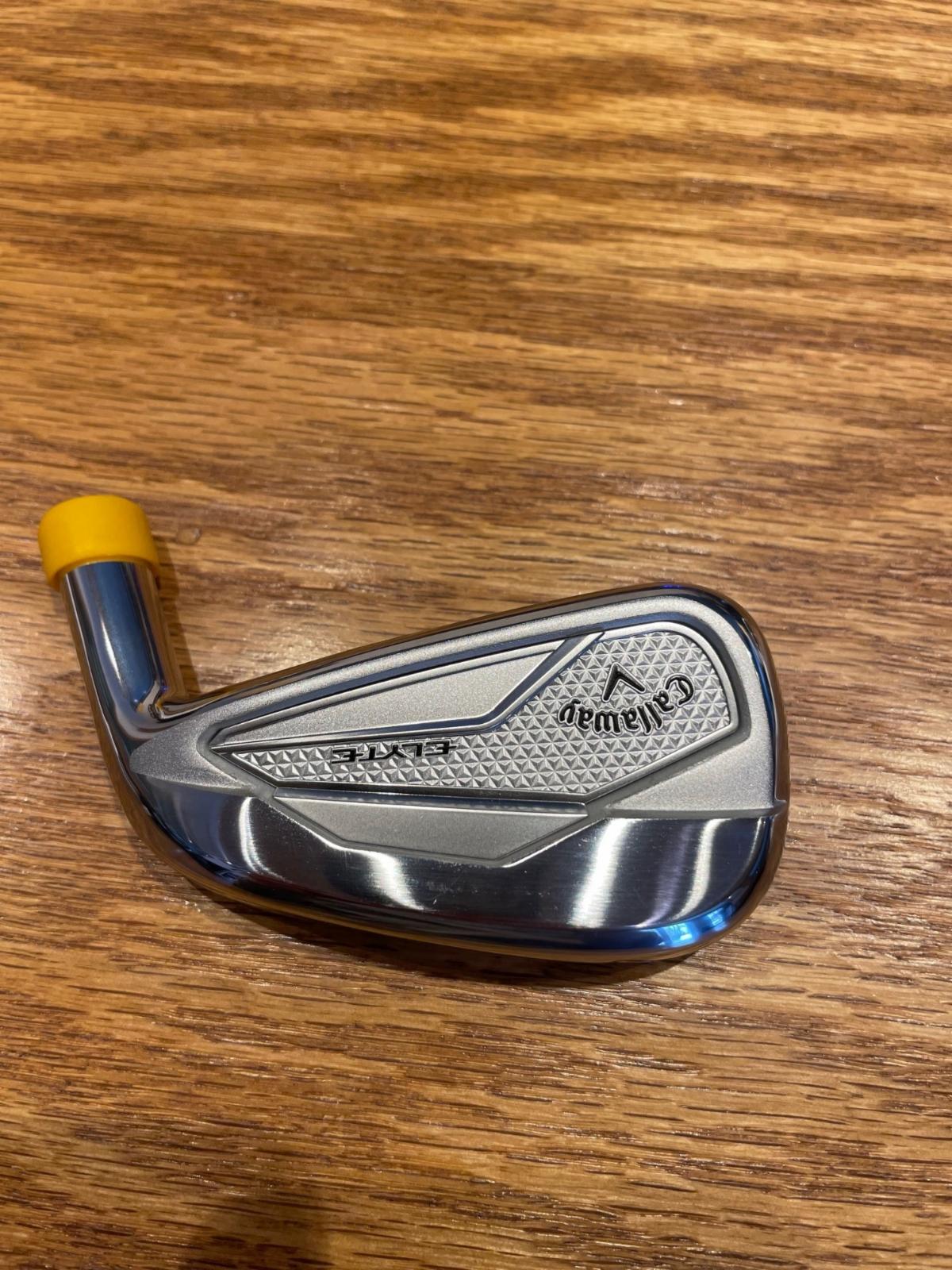
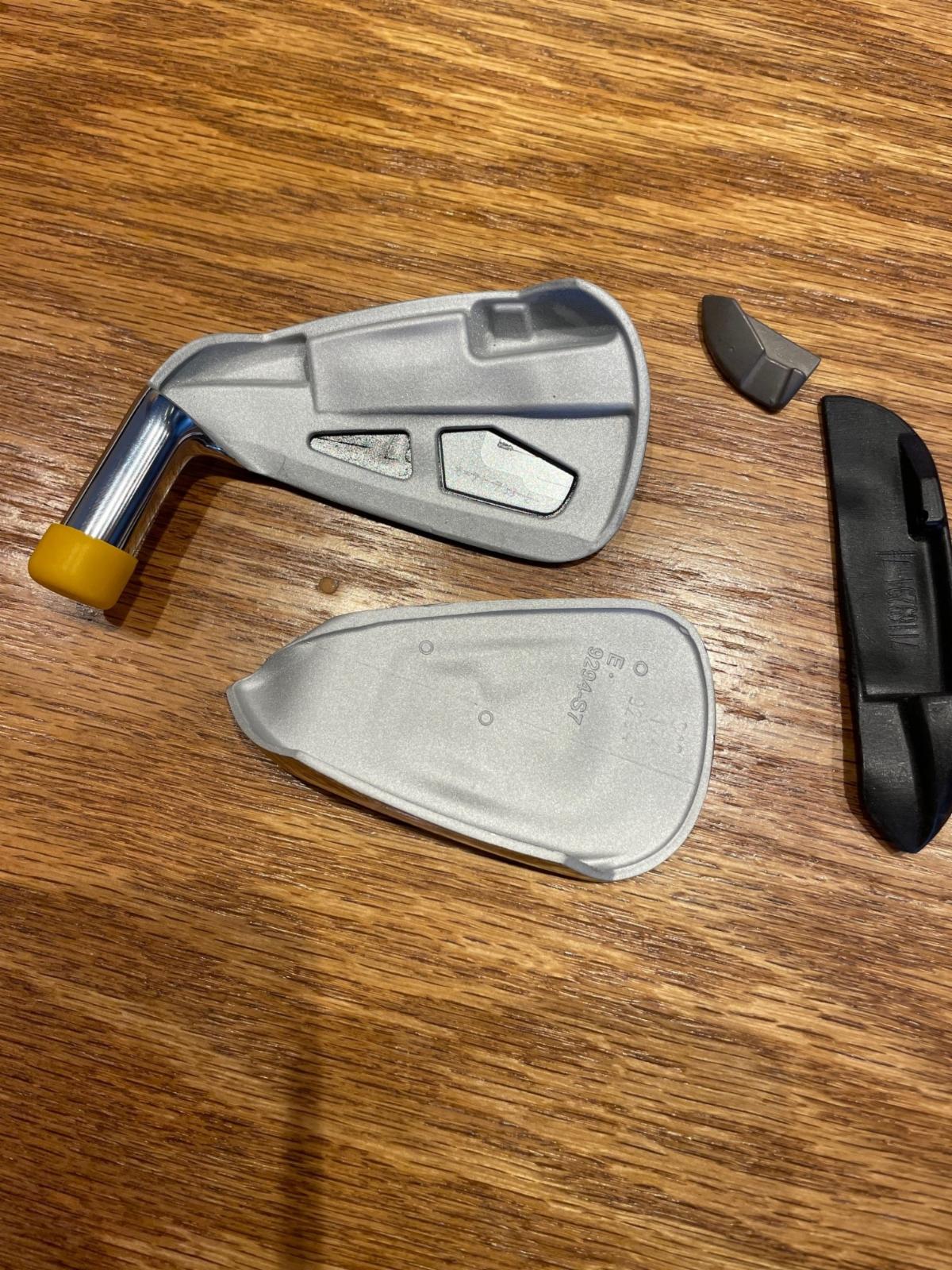
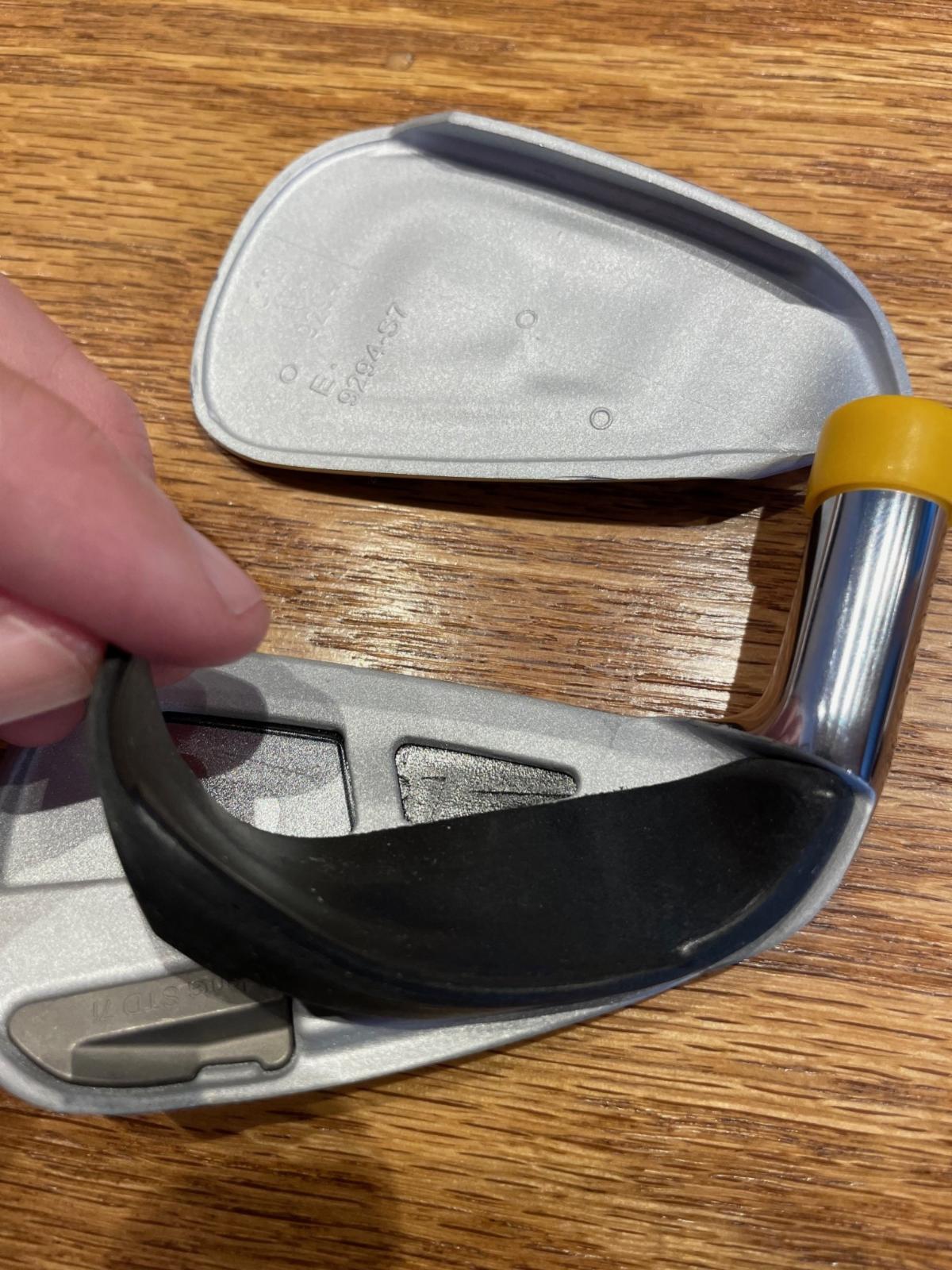
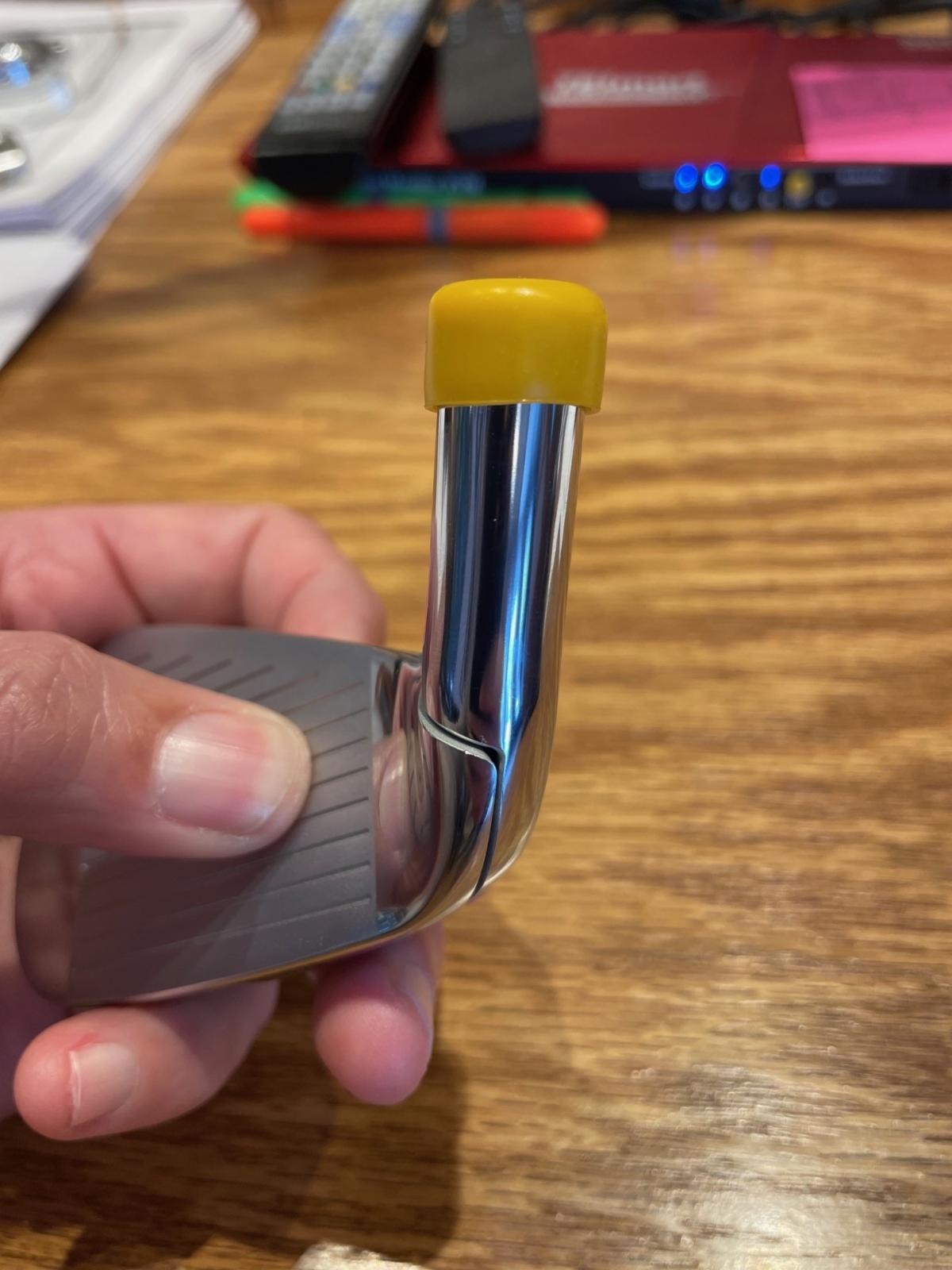
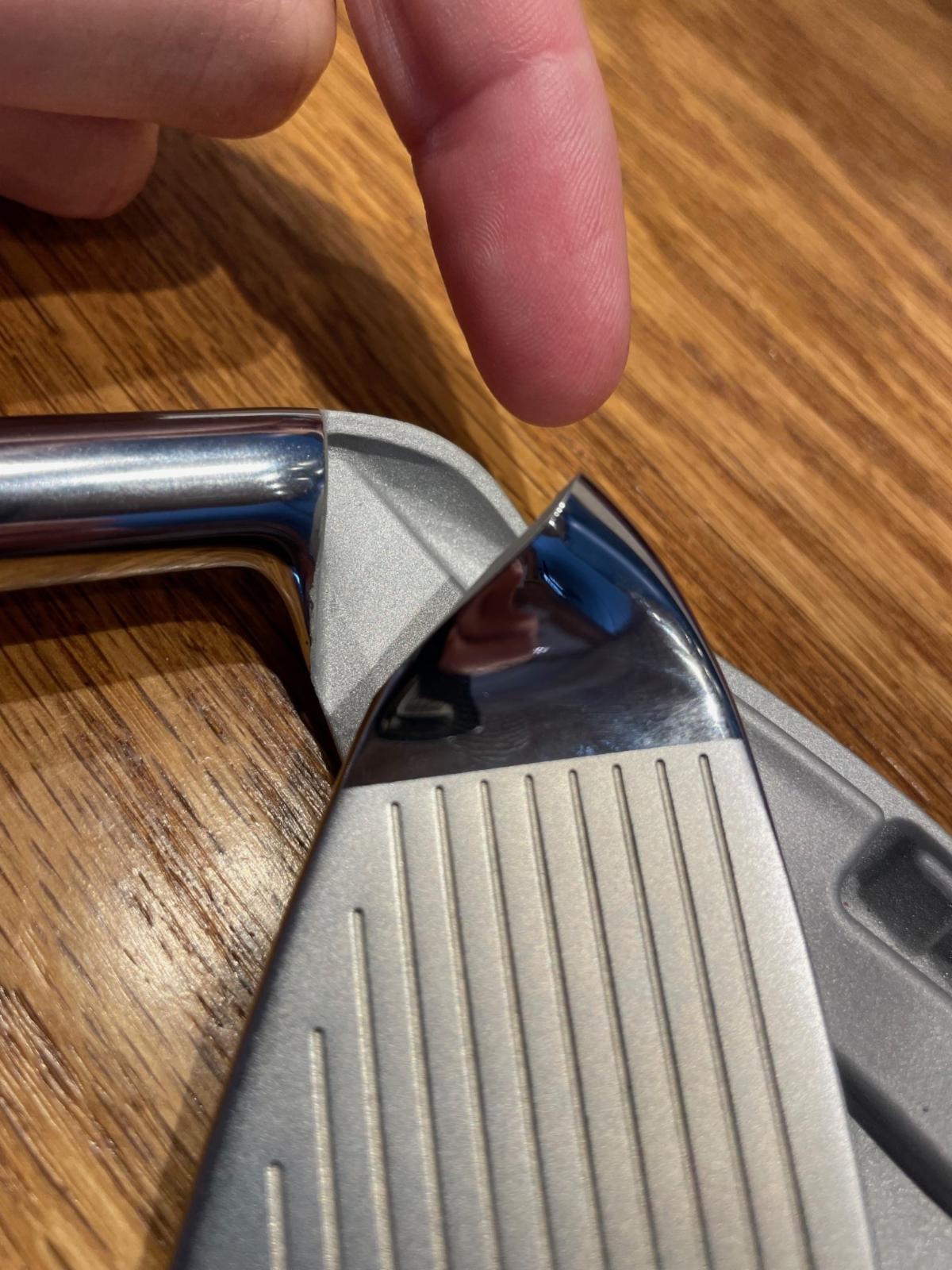
| A couple weeks ago, the Fitter’s Corner was about length and lie. It was a review. That was basic Fitting 101. It is essential knowledge to fit golf clubs. If you read the Product Place in the Callaway Newsletter, you learned all about the new Elyte Irons. I hope I got you thinking. Thinking WOW!! that is a lot of technology in that iron head. Let’s put the length and lie discussion to work, shall we? Let’s dive first into the HOW (we make these), then into the WHAT (you can do with them). The heads are made of four pieces plus a layer of Urethane gel with microspheres in injected in. In the pictures below, there is a plastic badge on the rear of the club that is affixed, so it looks like it is all part of the back. It’s not. It’s stuck to the back of the “Jailbreak” piece that runs up the middle of the club head. You can see the small piece of tungsten that goes low in the toe – this offsets the weight in the heel and adds to the size of the sweet area. Pictures make it easy to describe. Now… Pay close attention to how the head goes together. The face and the back of the body are plasma welded together. This is a very precise process that leaves a minimal amount of material left over, so there is not much grinding, smoothing and buffing that needs to be done after the welding process. By limiting this, the tolerances are much tighter. This is the how part of the equation. Now let’s dive into what this means for you. The weakest point of the head, however, is where the welds are. If we stress those areas too much, the joints will crack. That is what dictates what we can do with the lie angle of the club. Yes, the steel that we are using in this club is softer. That will influence how the club feels and also make it easier to bend in a loft/ lie machine. And here is where you have to be very careful if you have a loft/ lie machine and want to bend these on your own. Pay particular attention to WHERE the welds are. Across the crown and down the outside of the toe. It then recesses to the middle of the sole (remember “cup face”? This is it. This is what gives the face flex at the bottom of the face. This is to reduce distance loss on thin shots. Yes, this is patented and we are the only company doing it). Now, the scary part… Up the center of the heel into the hosel and across the base of the hosel back to the crown. It is this part that is particularly vulnerable on a loft/lie machine. Imagine where your bending bar will go. Imagine where you will stretch the steel to bend it. Right on that weld joint. The steel is easier to bend, so you have to be careful. Hopefully that makes sense to you. What are our spec ranges on these irons? We will go 3* UP to 3* FLAT, and 2* STRONG to 2* WEAK. To keep it simple – this is the spec on ALL of our irons. Apex forged? 3 UP to 3 flat, 2 strong to 2 weak. Wedges too. With length, we will go up to 2″ long, and down to 2″ short on EVERYTHING as well. This includes woods but not putters. Swing weight is the issue with changing the length. We do NOT have an alternate weight head, but we WILL pull heads that will spec out better for the length of the build you’d like. Here’s your refresher on swingweights. You will lose or gain 3 swingweight points with every half inch change in length, assuming all other factors are the same. A brief discussion of swingweight… Swingweight is a measure of balance. It tells us how heavy the head feels in relation to the overall weight of the club. Basically, how does it feel when you swing it. Swingweight. It’s measured on an odd scale – It used letters and numbers. A, B, C, D, E, F, etc. 0 through 9. There are 10 points per letter, so A0 through A9, B0 through B9, etc. It’s impossible to find something in the A’s, B’s might be for some junior clubs, and anything it the F’s is too heavy for a powerlifter to swing. Most clubs will be in the C’s and D’s, with the odd one in the lower E’s. D4 used to be standard in irons years ago, but that has gotten lighter through time. D2 is now widely accepted as the industry standard. Basically, the lighter the SW, the faster you can swing it. The heavier the SW, the more you can feel (and, theoretically, control) the club head. Many old timers (like me) prefer heavier swing weights, while the new generation prefers lighter… Not a rule, just an observation. Don’t be afraid to fit for swingweight if you can. Our standard swingweight is D2 in steel and D0 in graphite. Remember, as we change length, it’s 3 SW Points per half inch. So, if you add 1/2″, the swingweight will go to D5 in steel. Add 1 1/2″, and your swingweight is 9 points heavier – E1. That’s a heavy golf club. The reverse is also true. Make the club 1″ short for a male player, and add a graphite shaft, you are at D0 to start, less 6 swingweight points is C4. That is very light. Can you manipulate the swingweight in these cases. Yes. In three ways. You can use a heavier or a lighter head in the build process. We do what we can here. You can add lead tape to the back of the head. YUCK. It’s like adding lead tape to the back of a Rolex. That should be a hard pass for everyone. You can also change the grip weight. For every 4 grams we change on the handle side is about 1 swingweight point. Let’s go up to our +1/2″ scenario above. If we add a heavier grip – say a Multi compound Plus 4 midsize. That one is 15 grams heavier than the standard grip we use. That will get us down almost 4 SW points – we’d be in the D1 range. OK, now you’re talking… How about the other side? Our -1″ club that was going to be at C4. What if we added the same MCC +4 Midsize grip – you’d also drop 4 SW Points, so now that club is at C0. As a side note, changing the grip will have a minimal influence on the overall flex of the club as well. Heavier will reduce the stiffness slightly. Also, adding length will also generally decrease the flex of the shaft – the old guide was ONE full flex per 3/4″. The same is true in reverse if you make the shaft shorter. So, keeping that in mind, let’s go back to our -1″ senior with MCC +4 midsize grips. Not only will the swingweight be C0, but it will be over 1 full flex stiffer than what he wants (and thinks he’s getting). What do you do in this case? First, you shouldn’t fit to this spec. If this spec comes across my desk, expect a call from me. This will be an unplayable golf club. Can we make some changes to get this more in the ballpark? Can we go -1/2″ instead of -1″? That gets up 3 points. Can we do a Tour velvet Midsize instead of the MCC +4 Midsize? That gets us 10 grams lighter on the grip end. That’s another 2.5 points. C5 stinks, but it’s way better than C0. Digging deeper, Winn has some super lightweight grip options. They have a DriTac at 50 grams. That’s almost another 2 points. Now we’re at C7. We’re touching the STD SW of a ladies club. Winn offers a DriTac Lite Midsize grip at 23 grams… One point per 4 grams (standard is 50 grams). 27 grams lighter. That’s almost 7 points. That puts us at D4. Let’s go -3/4″ and get him closer to the length he wants. Then change the grip to the Winn DriTac lite midsize. That takes us to STD SW of D0 to roughly C5 at that length. The ultra-light grip adds 7 points back in and takes us to D1.5 or so. Due to the flex playing stiffer, we may want to have him try one flex softer (Ladies or F1 instead of men’s lite flex). THIS is a playable set of clubs. The same is true on the other side too – “Listen, at this extra length, these clubs are going to swing pretty heavy. We need a grip that’s a little heavier to balance out the extra weight. Are you OK with a Tour Velvet? They make a 55-gram version, and I can get the swingweight down a couple points…” Here’s the moral of the story. YOU are the fitter. YOU are the professional. YOU are the knowledge source. The player came to YOU for advice. You need to tell him what all of his “wants” are going to do to the golf club. Have him hit something as close to that spec as possible. It’s still not going to be the same. If you land on -1″, the question of “What grip do you want on these?” is not an option. The statement is “This is the grip we have to use. At this length, it’s our only option. Anything heavier than this and you will not be able to feel the head at all.” It’s also the same with lie angle. “Sir, we can only adjust these to 3* Upright. I know you are taller need a more upright lie angle, but there is a weld right through here. If we try to bend it any more than that we will over stress the joint and risk cracking it. 3* is the most we can go. They won’t even do more at the factory.” This is like handing the ball to the referee after you score a touchdown. Act like you’ve been there before – even if you haven’t. Happy Fitting!!! Jim Yeager, PGA |
  |
 |
 |
 |
 Jim Yeager Golf
Leave a comment