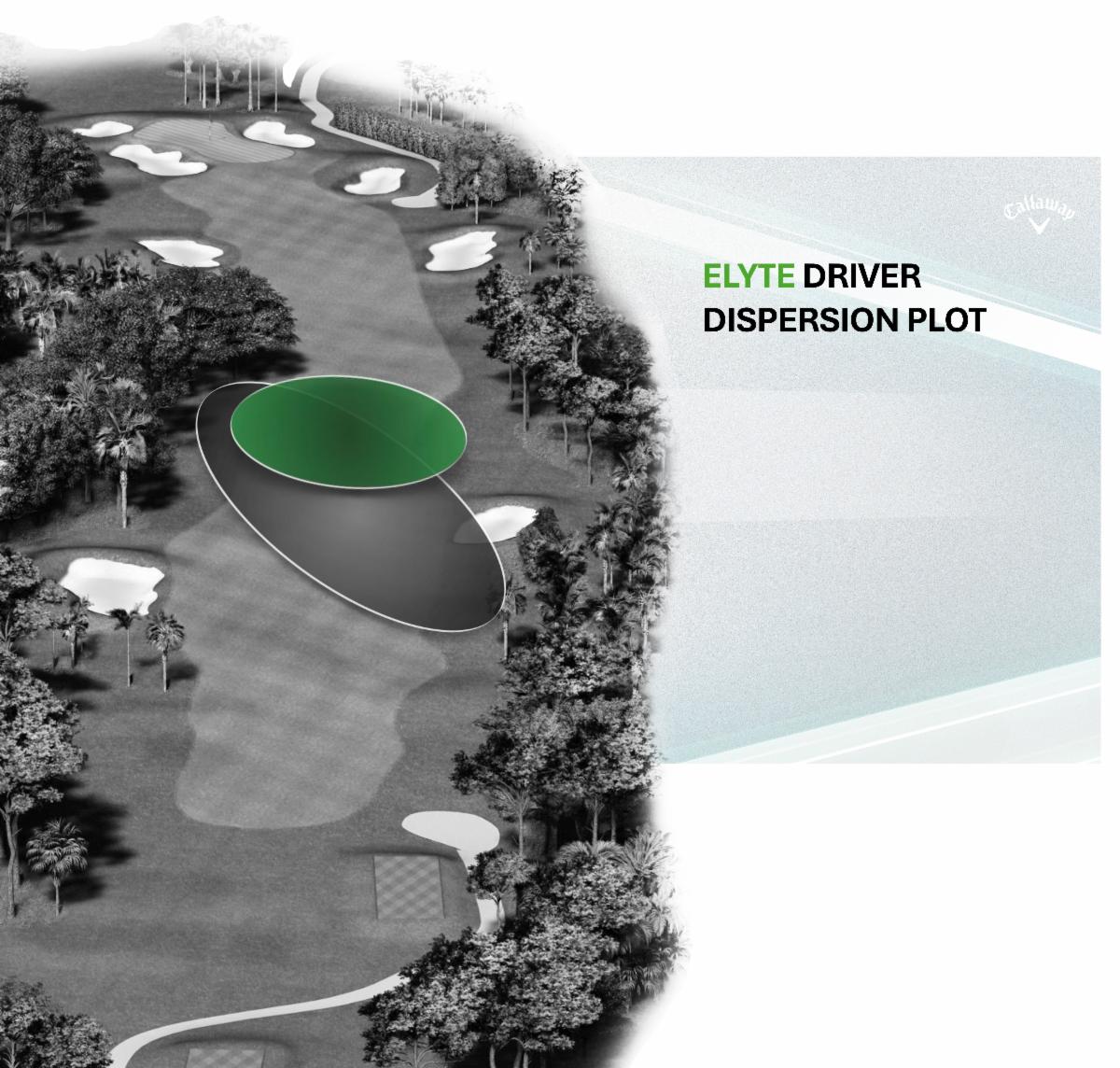
| The last Fitter’s Corner was about length and lie – a review. Fitting 101. Essential knowledge to fit golf clubs. I will continue on that pathway in future writings, but first, I want to shed some more light on fitting Elyte. Specifically, the driver. It has launched. You may have worked with it, you may not have. I talked about it. I worked with it. I’ve learned more about it. Knowing what I know is essential to SELLING this driver as you fit for it. If you read my other Monday morning email, you saw that I played a couple rounds with it in Mexico. I missed a fairway in 2 rounds. I had a good couple of days. I’ve seen other players hit it, and I’ve seen plenty of shots that would have missed every fairway in America. It’s a great driver, but it’s not a magic pill. How then do you SELL it?? Part of fitting is how you sell the results. How do you frame them? You have to understand what the results are telling you, and then figure out a way to articulate that to the player in a way that he understands. I want you to look at the two images below. This is testing that we have done internally with Elyte vs. Smoke. I’ve talked at length about how we flipped HOW we use AI, and we use AI now to make the face more forgiving. These images below demonstrate the results of shots hit all across the face of the Elyte driver vs. Last years #1 driver. In those images, notice how 30% of the grey circle COULD end up in that FW bunker on the right? Notice how 100% of the balls in the green circle ended up past the bunker on the right? To a smart player, who sees this hole, the tee shot needs to be played to the right side of the FW to not be blocked out by the trees. If 30% of the grey drives could end up in that bunker, that’s a 3 wood play all day long. Whereas if 100% of the green drives end up safely past the FW bunker, that’s a 50-60 yard advantage on the golf course. Folks, THIS is the answers to the test. When you have people hitting shots in your fitting bays, THIS is what you are looking for. I always tell players that I get excited about smaller circles. THIS is exactly what I mean. Ok, got it. So, how do you articulate it? How do you convey this to a player so he understands it? And, understands it well enough to pull the trigger on a new $600 driver?? Before you progress, consider this… Understand that he doesn’t know what he’s looking at. He see’s tables of numbers or a graphic of different colored circles. He’s looking to find which one has the highest total distance, or which circle is the furthest down range. A savvy fitter will look instead for smaller circles. Smaller circles means tighter dispersion. Tighter dispersion means more fairways, or closer to pins. Both of those things typically mean lower scores. Looking at the data that goes with the images below, a player could say “I hit both the same.” If he only looked at the longest distances with both, he’d be right. However, if you add in dispersion to the distance discussion, it’s easy to see that half of the shots with the grey driver are shorter than with the green driver. A fair number with grey are also in the rough, while only a couple with green are. Most players will give up a few yards for straight. Try this angle. I used it twice over the weekend and it really resonated. As you show the player his data, let him take it all in and get confused. Then ask the player what he sees. Most will say they are as long as each other, but I hit green straighter. I’d counter with this “You’re partially right. The longest shots with both are as long as each other. On average, though, green is significantly longer. Agreed?” Head nod. I’d continue “Why is this important?” Because my mis hits won’t be as bad? [Transition the discussion to distance consistency in something he understands – his irons]. “Exactly. Consider this. How long do you hit your 7-iron?” He will give you a yardage – say 150. He will not give you an average, or a range of 150 for a good one, 130 for a bad one. Golfers are wired to tell you how far they hit their good ones. So, you can play on that. I’ll ask “what’s the typical difference in distance between a good 7-iron and a bad one?” I dunno. Maybe 20 yards? “OK, so 130 – 150 is your 7 iron? That’s the difference between being short of the front bunker and on the green. If you could tighten that up, wouldn’t it be better?” Of course. Yes. [When it comes to a driver, a player will answer the same way – with the max yardage he can hit one on his best day]. “Keep all of this in mind, and let’s get back to the driver.” Show him his averages and compare his best ones and his worst ones. Use a 5 or 10 shot average of the shots he already hit. You can say “look, your good ones are just as long with both clubs, but your bad ones are 15-20 yards longer than your bad ones with this other club. That’s important when carrying hazards, bunkers, corners of doglegs, etc.” Then, ask the question, “Why should the driver be any different than your 7-iron? Distance control with the driver is every bit as important as it is with your 7-iron. Wouldn’t it be better if you had a driver where the good ones went the same distance as the longest driver you hit today, and the bad ones went further and straighter?” No one will say no to that question. Most players want to hit the ball longer. That means they want to improve on the good ones. That’s NOT what you’re trying to do!! You’re trying to fix the bad ones, not the best ones. You want to be a better player? Make the bad ones better. The bad ones are why he posts bad scores. THOSE are the ones you want to fix… He’ll probably hit his best ones about the same with any club. Figure out how often he hits a best one. Is it 1 in 10. 2 in 10? 1 in 20?? Maybe it’s 10% of the time. If it’s a better player, maybe it’s 50% of the time or more. The bottom line is that you are trying to fix the 90%, not make the 10% even better. If the 10% does get better in the process, bonus!!, but your goal is to make the 90% better. THAT is what all the technology in Elyte does. AND, it’s longer too. You don’t have to sell a short and straight in lieu of distance story. It’s as long as anything, and it’s straighter than everything. Add in that it’s more consistent on miss hits (meaning you don’t lose anywhere near as much), and you have a home run. You just need to know how to present it Happy Fitting!!! Jim Yeager, PGAJim Yeager – Blog |
 |
 |
 Jim Yeager Golf
Leave a comment